Why Good Selection Costs Less Than Poor Selection
The Story
“How much is this hiring process going to cost us?”
It was the first question the CEO asked.
A reasonable question.
But nobody asked the second one:
“How much will it cost us if we hire the wrong person?”
In an effort to reduce costs, the company decided to streamline its hiring process.
The solution seemed efficient.
- AI-based résumé screening;
- a free online assessment found on the internet;
- one unstructured interview lasting less than an hour.
The process moved quickly.
The selected candidate was impressive.
Confident. Articulate. Professional.
The résumé was flawless. The cover letter was persuasive. The interview performance was outstanding.
What nobody realized was that the candidate had used an entire ecosystem of AI tools.
CV generators. Interview preparation prompts. Chatbots simulating behavioural interviews.
Everything easily accessible. Everything completely legitimate. Several months later, reality emerged.
The candidate struggled with stress.
Adaptability was limited. Team tensions increased. Performance remained below expectations.
At the end of the year, HR presented a report.
The initial savings had disappeared. A replacement search became necessary.
Productivity had been lost.
Managers had invested substantial time correcting problems.
Turnover costs had accumulated. The hiring process had been inexpensive. The hiring decision had not.
What Does “Investment” Really Mean?
Many organizations still view recruitment primarily as a cost.
A budget line. An expense to minimize.
Yet selection is not merely an operational activity.
It is an economic decision. Every hiring decision allocates organizational resources toward an uncertain future outcome.
The objective is not to find a perfect candidate. The objective is to increase the probability of future success.
From this perspective, selection should be viewed as an investment rather than a cost.
🔬 Scientific Perspective
Organizational psychology has long developed models for estimating the economic value of selection decisions.
These approaches are commonly known as utility analysis.
They are not based on intuition.
They are based on measurable variables such as:
- predictive validity of assessment tools;
- expected performance differences between candidates;
- direct and indirect hiring costs;
- turnover rates;
- productivity outcomes.
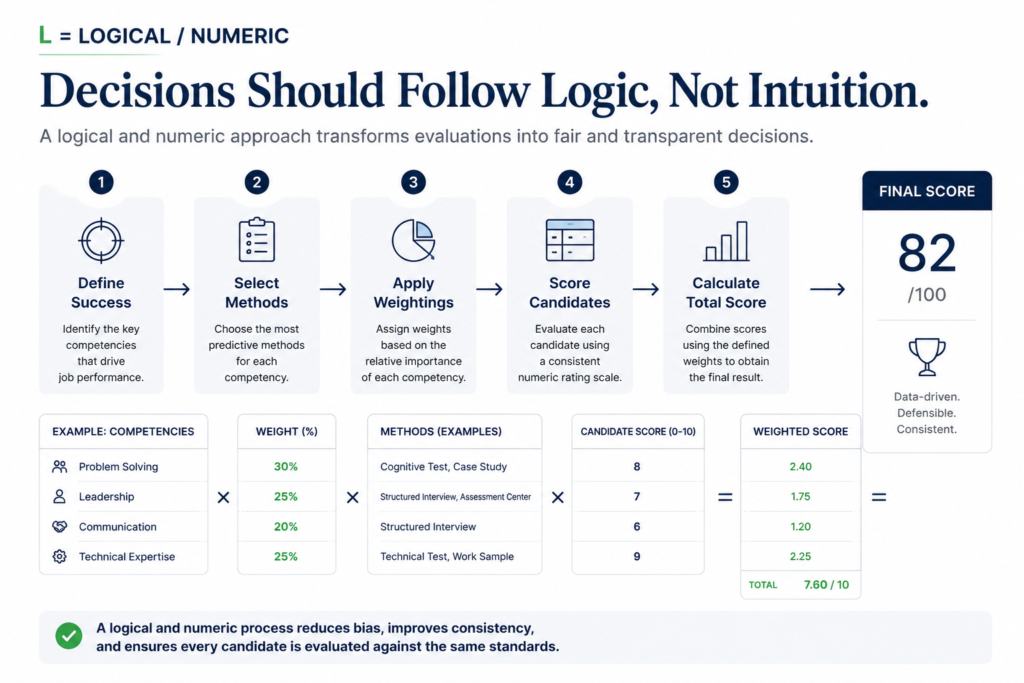
In other words:
A trained HR professional can estimate the expected economic return of a selection process.
The challenge is not that these models do not exist. The challenge is that they are rarely used.
Selection as a Probabilistic Investment
Scientific selection does not eliminate uncertainty.
Nothing can. Selection is fundamentally a probabilistic decision. The purpose of selection is not to guarantee success. It is to improve the odds. A completely random hiring decision has an expected value close to zero.
Surprisingly, it is often less harmful than a process dominated by bias, intuition, or unstructured impressions.
Why?
Because biased decisions create an illusion of certainty without increasing predictive accuracy.
Scientific selection creates value because it predicts performance better than chance. That is precisely what predictive validity measures. When predictive validity is weak, organizations are not really selecting. They are rationalizing random choices.
🤖 Why Investment Matters More Than Ever in the Age of AI
Artificial intelligence does not create the problem. It amplifies it.
Today organizations use AI to evaluate candidates. At the same time, candidates use AI to optimize applications.
This creates an escalating cycle. Better screening systems. Better optimization tools. Better filtering. Better manipulation.
In computer science, similar dynamics are observed in adversarial systems designed specifically to bypass recognition algorithms.
The same principle increasingly applies to recruitment.
AI can help candidates:
- optimize résumés;
- prepare structured interview responses;
- design applications that pass automated filters.
When hiring processes rely heavily on superficial signals, AI usually wins.
The weaker the process, the greater the vulnerability.
Paradoxically, the more AI enters recruitment, the more important scientific assessment becomes.
The Hidden Cost of Counterproductive Selection
The greatest danger is not simply making a wrong hiring decision.
It is making a counterproductive one.
A decision that:
- reduces performance;
- increases turnover;
- damages team climate;
- creates managerial overload;
- generates hidden organizational costs.
These costs are rarely measured systematically. And because they are rarely measured, they are often ignored. Confirmation bias reinforces the problem. Organizations tend to remember successful hires and rationalize unsuccessful ones. The absence of systematic follow-up makes learning difficult.
From an economic perspective, this makes underinvestment in selection surprisingly irrational.
The VALID Perspective
Within the VALID framework, selection is treated as an investment decision.
The Selection Plan provides the foundation for estimating expected value by connecting:
- performance objectives;
- candidate characteristics;
- assessment methods;
- decision criteria.
The more valid, reliable, and logical the process becomes, the more defensible its economic value becomes.
VALID does not ask:
“How much does selection cost?”
VALID asks:
“What is the expected return of making better hiring decisions?”
👥 For HR Specialists
Questions Worth Asking
Consider your current recruitment process.
- What is the cost of a failed hire?
- How often do you measure hiring outcomes after onboarding?
- Can you estimate the economic value of improving hiring quality?
- Are selection decisions evaluated against subsequent performance?
- Are you investing in methods that improve prediction, or merely reduce immediate costs?
Many organizations measure recruitment expenses.
Far fewer measure recruitment value.
Why Investment Protects Everyone
For organizations, investment-oriented selection creates better performance, lower turnover, and stronger long-term results.
For HR professionals, it creates a defensible business case for scientific assessment.
For candidates, it increases the probability of being matched to roles where they can genuinely succeed.
Selection is therefore not simply about reducing risk.
It is about creating value.
🎯 Key Takeaway
The fourth letter of VALID reminds us of a simple principle:
Selection is not a cost to minimize.
It is an investment whose value can be measured.
The more valid, reliable, and logical the process becomes, the more defensible the investment becomes.
I = Investment.
Continue the VALID Series
Next article:
D — Differentiating: Why Selection Only Creates Value When It Can Distinguish Between Candidates

