When Selection Must Actually Distinguish Between Candidates
The Story
Two candidates have reached the final stage.
The HR team presents comprehensive reports.
Personality profiles. Interview summaries. Assessment results.
Pages of observations and comments.
Management listens carefully. Everyone nods. Then the discussion begins.
“I find this candidate more motivated.” “Yes, but I see more long-term potential in the other.”“It depends on what kind of leader we want.” “Both could probably succeed.”
The conversation continues. More information is exchanged. More interpretations are added. And yet, strangely, nobody feels closer to a decision.
Not because information is missing. But because no shared decision criterion exists.
What Does “Differentiating” Really Mean?
Many selection processes generate information. Far fewer generate decisions.
A process is not differentiating because it is complex. It is differentiating only when it can clearly explain why one candidate is a better fit than another.
The purpose of assessment is not merely to describe candidates. The purpose of assessment is to distinguish among candidates.
When the final outcome remains a debate between competing interpretations, the process has not completed its job. It has simply transferred responsibility to the decision makers.
🔬 Scientific Perspective
Selection science is fundamentally comparative.
Organizations rarely ask: “Is this candidate good?”
They ask: “Which candidate is better suited for this role?”
This distinction is crucial.
Many assessment methods are excellent at describing people.
Fewer are designed to support comparison.
Without a common metric:
- assessment results cannot be integrated;
- candidates cannot be ranked consistently;
- decision quality decreases.
The challenge is therefore not generating more information. The challenge is transforming information into meaningful differentiation.
🤖 Why Differentiation Matters More Than Ever in the Age of AI
Artificial intelligence is increasing the quality of candidate self-presentation.
Applications are becoming more polished. Interviews are becoming more rehearsed. Personal branding is becoming more sophisticated.
As a result, many candidates appear increasingly similar on the surface.
The consequence is paradoxical.
Organizations often have more information than ever before. Yet distinguishing between finalists becomes increasingly difficult.
The stronger candidates become at presenting themselves, the more important it becomes to rely on structured differentiation rather than subjective impressions.
The challenge is not identifying good candidates. The challenge is identifying the best candidate for a specific role.
The VALID Perspective
Within the VALID framework, differentiation is achieved through the Selection Plan.
The purpose of the Selection Plan is not simply to evaluate candidates.
Its purpose is to create comparable outputs.
An effective Selection Plan produces:
An Overall Selection Score
A final percentile score that allows candidates to be ranked.
Performance Scores
Percentile scores for each expected performance dimension identified as important for the role.
WRC Scores
Percentile scores for each Work-Related Characteristic included in the Selection Plan.
Most importantly, all scores are expressed on the same metric.
Percentiles.
This makes them:
- comparable across candidates;
- comparable across dimensions;
- comparable against predefined standards established by the organization.
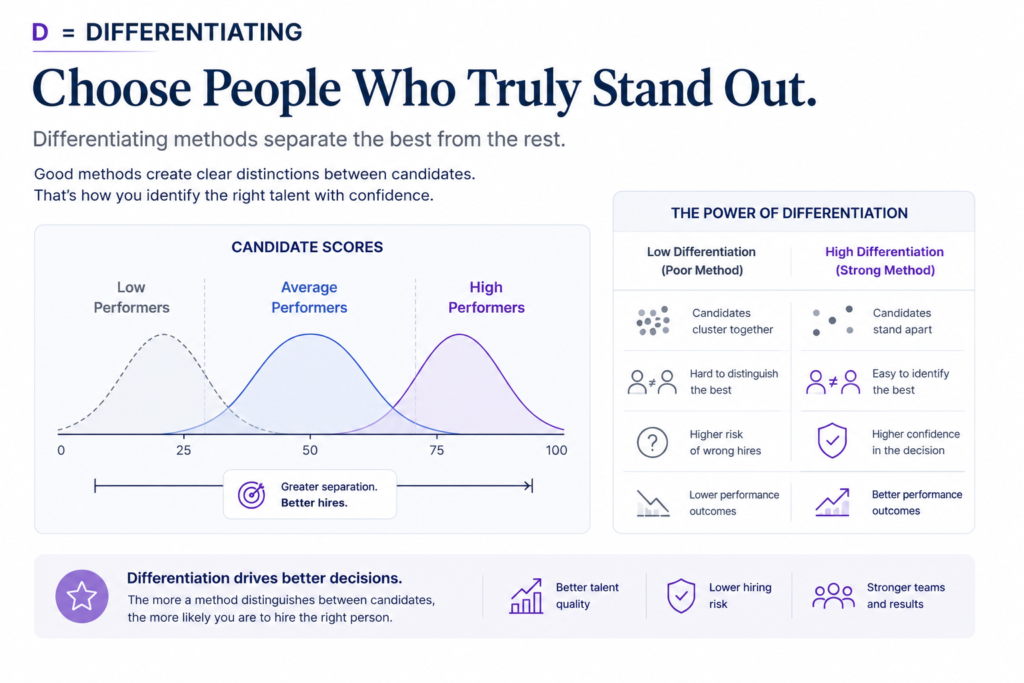
The result is not a collection of separate reports. The result is a coherent decision framework.
The Two Levels of Comparison
Within VALID, selection decisions occur at two complementary levels.
Level 1: Overall Ranking
The first step is simple.
Candidates are compared using their overall Selection Score.
This allows the process to perform its primary function:
Ranking alternatives.
Level 2: Structured Profile Comparison
The second step involves examining performance dimensions and WRC profiles.
This is where trade-offs become visible.
One candidate may score higher overall.
Another may show a unique strength particularly relevant to the role.
This comparison is no longer based on intuition.
It is supported by a common structure.
Why Bullet Graphs Matter
Visualization is not a cosmetic choice. It is part of the decision process.
VALID uses bullet graphs because they can display, in a compact and readable format:
- candidate scores;
- performance thresholds;
- reference standards;
- relative importance of dimensions.
At a glance, decision makers can identify:
- where a candidate excels;
- where performance is adequate;
- where risks or weaknesses exist.
The purpose is not to simplify the decision. The purpose is to make the decision possible.
👥 For HR Specialists
Questions Worth Asking
Consider your current hiring process.
- Can candidates be compared using a common metric?
- Can you explain why Candidate A ranked above Candidate B?
- Do different reports contribute to a single decision framework?
- Are final decisions based on data or on the final discussion in the meeting room?
- Could you defend your ranking if challenged by management or candidates?
Many organizations have sophisticated assessment tools. Far fewer have a structured differentiation system.
Blind Comparison and Bias Reduction
One of the most powerful applications of differentiation occurs during the final decision stage.
Within VALID, candidate results can be reviewed before identities are revealed.
No names. No age. No personal background. No anecdotal impressions.
Decision makers first compare data.
Only afterward do they discover who the candidates are.
This simple practice can dramatically reduce the influence of unconscious bias and shift attention toward role-relevant evidence.
Why Differentiation Protects Everyone
For organizations, differentiation creates clearer and more defensible decisions.
For recruiters, it reduces conflict between competing interpretations. For candidates, it increases transparency and perceived fairness.
A process that cannot distinguish among candidates creates uncertainty. A process that differentiates creates confidence.
🎯 Key Takeaway
The final letter of VALID reminds us of a simple principle:
A selection process creates value only when it can truly distinguish between candidates.
When a process cannot differentiate, it is not neutral.
It is simply undecided.
D = Differentiating.
The VALID Framework
V – Valid
Predict performance.
A – Accurate & Reliable
Produce trustworthy results.
L – Logical & Numerical
Transform information into decisions.
I – Investment
Create measurable economic value.
D – Differentiating
Distinguish clearly between candidates.
Together, these five principles form the foundation of scientific selection in the age of AI.

