When Selection Becomes an Opinion Because Nobody Agreed on the Numbers
The Story
Two finalists remain.
Marco and Alessia.
The position is Team Leader.
The HR team presents the results of two assessment tools: a DISC profile and a Big Five assessment.
Marco appears highly dominant and influential in the DISC profile.
In the Big Five assessment, he shows:
- high Extraversion;
- moderate Conscientiousness;
- low Emotional Stability.
Alessia presents a very different profile.
She appears more reserved in the DISC assessment.
In the Big Five results, she shows:
- high Conscientiousness;
- moderate Extraversion;
- high Emotional Stability.
The CEO immediately expresses a preference.
“Marco has more energy. We need someone who can drive the team.”
The HR Manager disagrees.
“Alessia is more stable, more organized, and probably more reliable over time.”
Both are using psychological arguments. Both are referring to assessment data. Both have experience.
Yet the decision stalls.
Why?
Because there is no agreed numerical criterion that allows comparison.
Only interpretations.
What Does “Logical & Numerical” Really Mean?
Many organizations assume that collecting information is enough.
It is not.
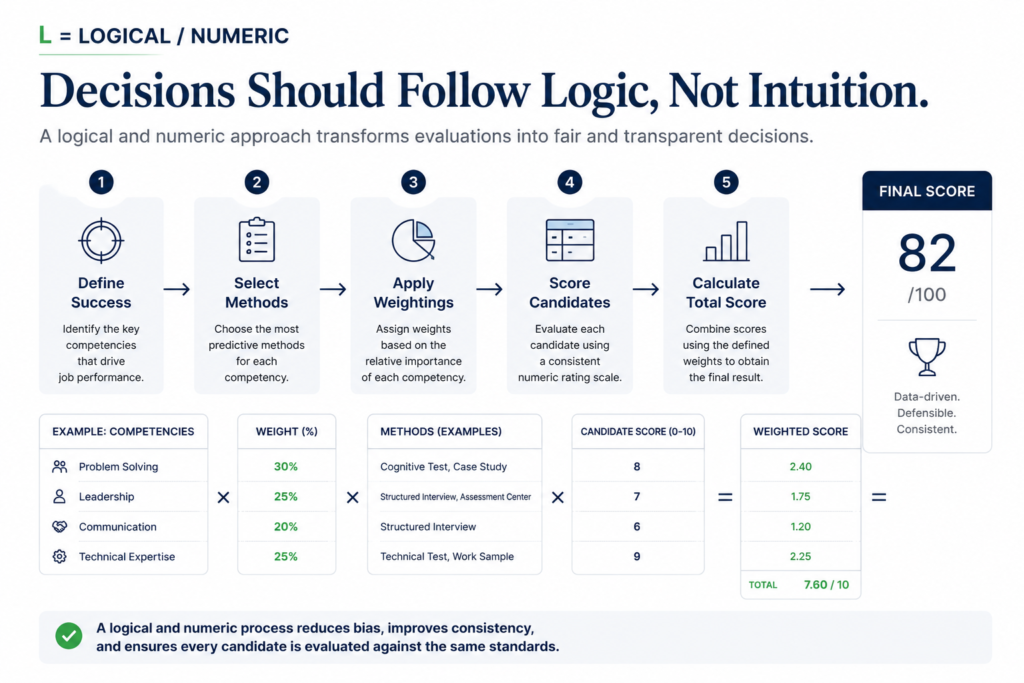
A selection process becomes logical when it transforms complex information into a decision that can be compared, explained, and defended.
Logical does not mean reducing people to numbers.
It means translating multiple sources of information into a consistent decision-making framework.
Without that step, even the best assessment becomes a story. Interesting. Sophisticated. Perhaps insightful. But ultimately difficult to use for decision-making.
The problem is rarely the assessment tool itself. The problem is the absence of a combination rule.
🔬 Scientific Perspective
In personnel selection, information comes from many different sources:
- interviews;
- personality assessments;
- cognitive tests;
- work samples;
- behavioural observations;
- references.
Each source provides a partial view of the candidate.
The challenge is not collecting data. The challenge is integrating it.
Selection science has long recognized that combining predictors systematically produces better decisions than relying on intuition alone.
The critical question therefore becomes:
How should different pieces of information be combined?
This is known as the combination rule.
Without a combination rule, decision-making becomes vulnerable to recency effects, confirmation bias, halo effects, and personal preferences.
With a combination rule, the process becomes transparent and replicable.
🤖 Why Logical Selection Matters More Than Ever in the Age of AI
Artificial intelligence is increasing the amount of information available during recruitment.
Organizations now have access to:
- automated screening systems;
- AI-generated summaries;
- interview analytics;
- candidate assessments;
- behavioural data.
The risk is not having too little information. The risk is having too much information.
Without a logical structure, additional data simply creates additional confusion.
AI can generate more signals. But only a structured decision framework can transform those signals into a meaningful hiring decision.
The challenge is not collecting more data. The challenge is making better decisions with the data already available.
The VALID Perspective
Within the VALID framework, the combination rule is formalized through the Selection Plan.
The Selection Plan transforms assessment results into:
A Performance Vector
This vector represents the candidate's expected performance across the dimensions identified as critical for the role.
Examples might include:
- Task Performance;
- Organizational Citizenship Behaviour;
- Adaptive Performance.
A WRC Vector
This vector represents the candidate's standing on the Work-Related Characteristics identified as predictive of those performance dimensions.
Examples might include:
- cognitive ability;
- achievement striving;
- emotional stability;
- teamwork orientation.
A Final Selection Score
The final score summarizes the candidate's overall fit for the position.
Candidates are ranked according to this score. The highest score represents the strongest predicted fit for the role.
The Selection Plan therefore translates:
Assessment Results → WRC Scores → Performance Predictions → Selection Decision
This creates a clear bridge between measurement and decision-making.
👥 For HR Specialists
Questions Worth Asking
Consider your current recruitment process.
- How are assessment results combined?
- Which criteria receive the greatest weight?
- Would another recruiter reach the same conclusion using the same information?
- Is the final decision driven by a predefined rule or by the last discussion in the meeting room?
- Can you explain why Candidate A was selected over Candidate B?
Many organizations discover that they have excellent assessment tools but no explicit decision model.
Without a decision model, the process often defaults to opinions.
The Language of Decision-Making
Numbers do not replace professional judgment.
They make professional judgment explicit.
A meaningful selection score emerges only when:
- performance dimensions have been defined in advance;
- relevant WRC have been identified;
- priorities and weights have been established;
- assessment results have been integrated consistently.
Only then does selection become:
- comparable;
- replicable;
- defensible.
Ideally, scores should also be expressed as percentiles.
Percentiles allow comparison not only among candidates in the same process but also against a broader normative reference group.
A percentile score of 55, for example, indicates that the candidate performs better than approximately 55% of the relevant reference population on that dimension.
Why Logical & Numerical Selection Protects Everyone
For recruiters, a shared numerical framework reduces conflict between competing opinions and creates accountability grounded in evidence.
For candidates, it means being evaluated according to transparent rules rather than persuasion skills, interview charisma, or strategic self-presentation.
Particularly in an AI-enabled world, this distinction becomes increasingly important.
Without numerical logic, selection remains vulnerable.
With numerical logic, selection becomes transparent.
🎯 Key Takeaway
The third letter of VALID reminds us of a simple principle:
Without a number, there is no comparison.
And without comparison, there is no decision.
L = Logical & Numerical.
Continue the VALID Series
Next article:
I — Investment: Why Scientific Selection Is Not a Cost, but an Economic Decision

