When a Selection Method Actually Predicts Performance
The Story
Silvia had done everything right.
She carefully reviewed dozens of applications, selected the strongest CV, conducted several interviews, and eventually chose Marco.
His résumé was impressive. His motivation letter was convincing. His interview answers were polished and professional.
Three months later, however, something was not working.
Marco struggled with the day-to-day demands of the role. Deadlines slipped. Team members complained. Performance remained below expectations.
Silvia was surprised.
After all, Marco had performed exceptionally well throughout the selection process.
Or had he?
Months later she discovered that Marco had used AI tools to optimize his CV, generate tailored cover letters, and rehearse interview answers.
Nothing unethical. Nothing unusual.
But something important.
The real question was not whether Marco had used AI.
The real question was:
Was the selection process actually capable of predicting job performance?
What Does “Valid” Really Mean?
In everyday HR language, the word valid is often used loosely.
- A questionnaire "is valid" because it is popular.
- An interview "is valid" because experienced recruiters use it.
- An assessment "is valid" because it produces a professional-looking report.
In organizational psychology, validity means something much more precise.
A selection method is valid when it predicts future job performance.
Not when it creates a good impression. Not when it feels convincing. Not when it is widely used.
When it predicts performance.
If a method cannot predict performance, it may still be interesting, engaging, or persuasive—but it is not helping the organization make better hiring decisions.
🔬 Scientific Perspective
This is where science becomes important.
A valid selection process relies on tools supported by empirical evidence: studies, meta-analyses, and statistical data showing a meaningful relationship between what is measured during selection and what will later happen on the job.
This has an important implication:
Recruiters do not decide what predicts performance. Scientific evidence does.
Research accumulated over decades suggests that some methods are significantly better predictors of performance than others.
Well-designed work samples, cognitive ability tests, targeted personality assessments, and structured interviews supported by behavioural rating scales have consistently demonstrated predictive validity.
By contrast, unstructured interviews, impression-based evaluations, references, and—in many situations—even biodata such as CVs tend to be less predictive because they are more vulnerable to bias, impression management, and contextual distortions.
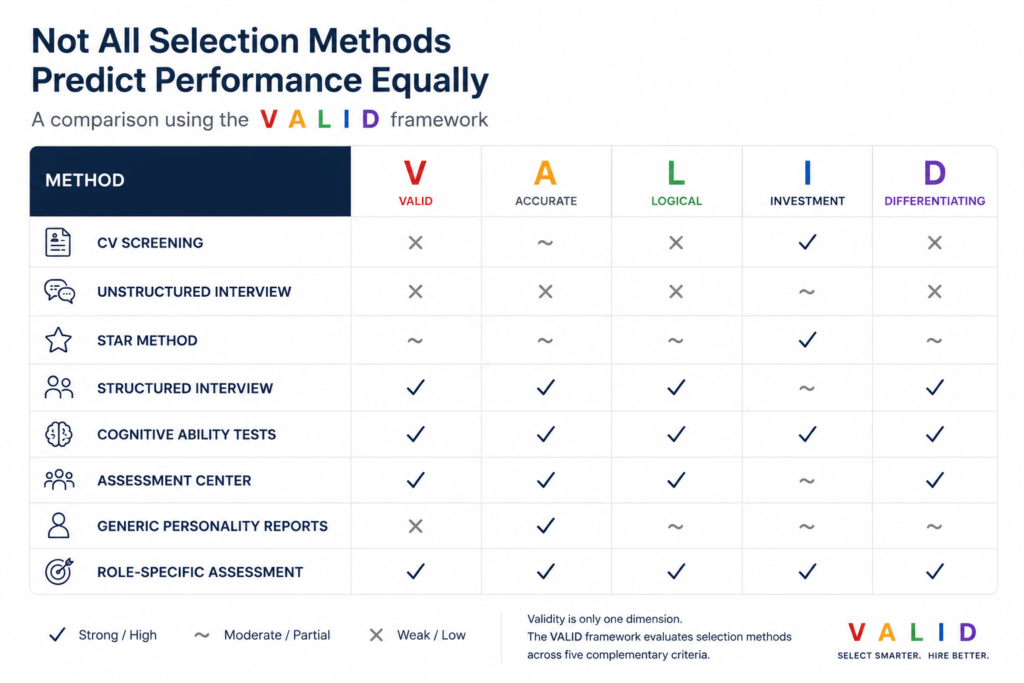
And this becomes even more relevant in a world where AI makes many selection signals easier to optimize.
🤖 Why Validity Matters More Than Ever in the Age of AI
Artificial intelligence did not create the validity problem.
It simply made it visible.
Today candidates can:
- generate highly tailored CVs;
- create persuasive cover letters;
- prepare STAR interviews with AI coaches;
- optimize applications for Applicant Tracking Systems.
Organizations are doing the same from the other side, using AI to screen applications and support recruitment decisions.
The result is not a battle between recruiters and candidates. The result is that weak selection methods become even weaker.
If a process relies primarily on signals that can be rehearsed, optimized, or manipulated, it risks selecting presentation skills instead of future performance.
The challenge is not AI.
The challenge is maintaining predictive validity in an AI-enabled world.
The VALID Perspective
The VALID framework starts from a simple principle:
Selection begins with performance.
Before discussing interviews, questionnaires, assessments, or AI, we ask:
What does successful performance look like in this role?
Only then do we identify:
- the Work-Related Characteristics (WRC) that predict that performance;
- the assessment tools capable of measuring those characteristics;
- the scoring procedures used to compare candidates.
This leads to the creation of a Selection Plan.
A Selection Plan explicitly links:
Performance → Predictors → Assessment Methods → Decision Criteria
The plan is designed once for a position and then applied consistently across candidates.
This is one of the most important contributions an HR specialist can make. Experience matters. But experience cannot replace validity.
Without valid methods, experience can easily become overconfidence.
👥 For HR Specialists
Questions Worth Asking
Take a moment and reflect on your current selection process.
- Which stages are supported by evidence of predictive validity?
- Which decisions rely primarily on impressions?
- Which tools have been selected because they are convenient rather than predictive?
- If two recruiters assessed the same candidate, would they reach the same conclusion?
- Are you measuring characteristics that predict performance, or characteristics that are simply easy to observe?
Many organizations discover that their biggest vulnerability is not a lack of technology.
It is a lack of validity.
Why Validity Protects Everyone
A valid process protects the organization because it reduces the risk of costly hiring mistakes.
But it also protects candidates.
Candidates are evaluated on characteristics that genuinely matter for performance rather than on their ability to impress, perform in interviews, or master recruitment tactics.
When a process is valid:
- selected candidates are more likely to succeed;
- rejected candidates are more likely to perceive fairness and consistency;
- organizational credibility is strengthened.
Validity is therefore not only a technical requirement.
It is also a professional and ethical responsibility.
🎯 Key Takeaway
The first letter of VALID reminds us of a simple but uncomfortable truth:
If a method does not predict performance, it is not a good selection method.
Even if it is popular.
Even if it is familiar.
Even if it appears to work
V = Valid.
Continue the VALID Series
Next article:
A — Accurate & Reliable: Can You Trust Your Selection Results?

